Saturday, May 04, 2013


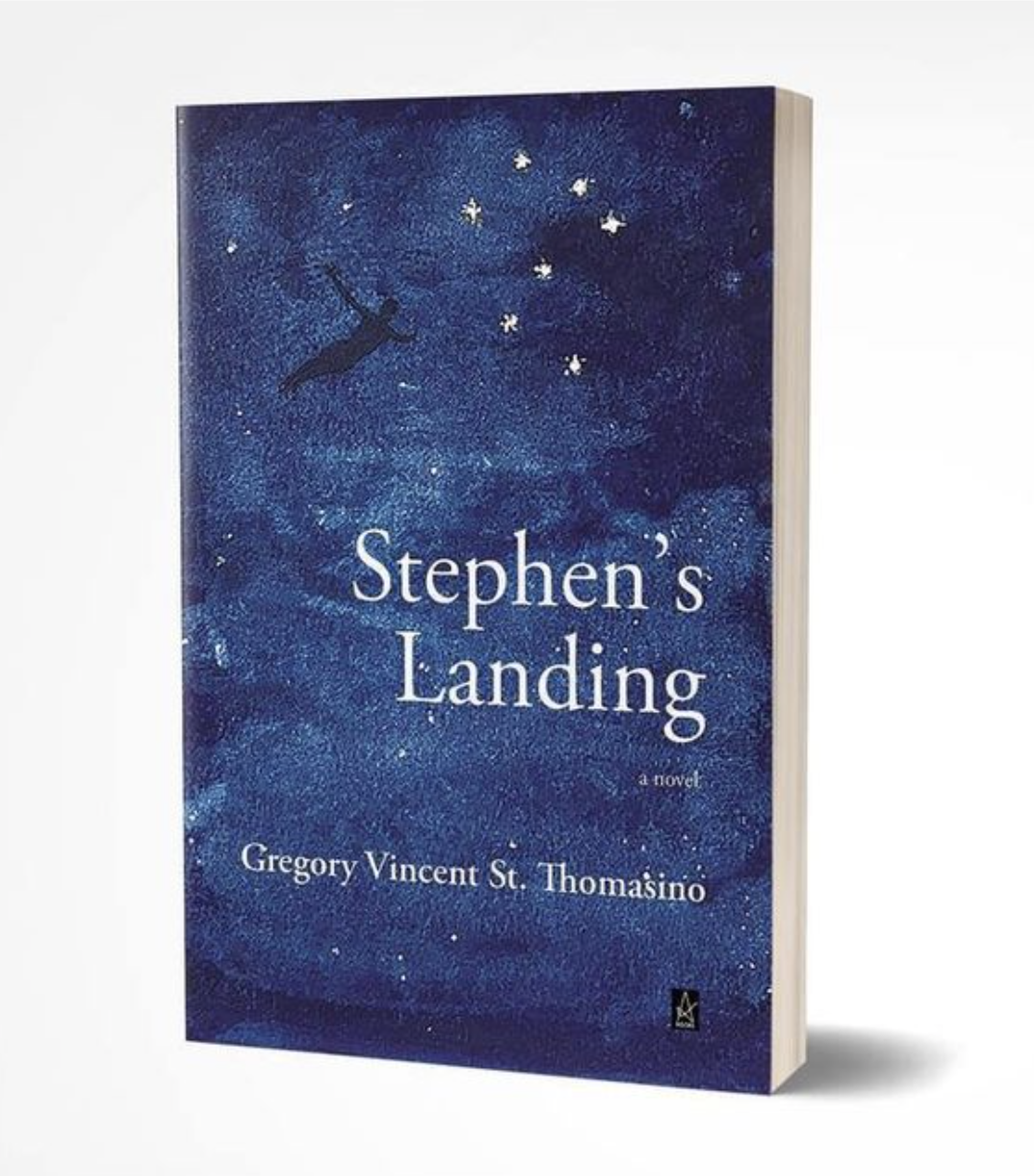
a noun sing e·ratio 17 . . . featuring The Swing, an artist's book by Elena Berriolo . . . an e·chap by Anne Gorrick . . . and new work by 25 poets.

edited by Gregory Vincent St. Thomasino with contributing editor Joseph F. Keppler


Wednesday, April 17, 2013


E·ratio issue 17 is in production. Proofs will be going out soon.

e· 

Wednesday, March 27, 2013

The complete catalogue for the Rhythm of Structure: Mathematics, Art and Poetic Reflection show is available to read online at issuu. Look for works by Bob Grumman, Kaz Maslanka and Gregory Vincent St. Thomasino on pages 54 and 55.

Sunday, March 24, 2013


On Mathematical Poetry (Post Four)

(On Mathematical Poetry (Post Four) was originally going to be about “mathematical prose.”  I’ll post those notes in the near future.  In the meantime, regarding “mathematical prose,” see below for paraphrase and the mathematical statement.) 


Notes on Bob Grumman’s Christmas Mathemaku
and on mathematical poetry generally, or, how to deconstruct a division sign


First things first:  I think the only fair and general term that one [that we?] should use is “math-themed poetry.” 

I think the term “mathematical poetry” ought to always be in quotation marks.  And one [and we?] should use the term, “math-themed poetry.” 

I think it is fair, and within our power, to maintain that this poetry is “influenced” by mathematics.  But the claim that this poetry is “carrying out a mathematical operation,” has, in my opinion, not been substantiated and is, in my opinion, false. 

The reasons for these things ought to be immediately obvious (and if they are not, then I think we’ve gone beyond the usual skepticism and cynicism and have entered the realm of the incredulous). 

If there is indeed something we can locate and identify as the math-themed poetry community, then it is in no way a “close-knit” community, but is made up of quite various and distinct individuals (not all of whom are established poets) with quite various and distinct ideas as to what a math-themed or “mathematical” poetry should look like, and a constellation of probably only three so-dedicated blogs.  I am concerned here with just one creator of math-themed poetry, Bob Grumman, because Bob has probably been doing it the longest and his is the work that I am most familiar with (having interviewed him on the subject and, probably, having written more words than anybody else on his work), and because Bob claims that his “mathemaku” “in long division” is actually “carrying out a mathematical operation.”  And because Bob has a blog at the Scientific American Blog Network, with respect to which I am writing this in the spirit of a peer review. 

Which raises an interesting question: Who is the “math-themed” poet’s peer?  The poet or the mathematician? 

One particular opinion, which I have frequently encountered, holds that only the capital M mathematician is a real mathematician while anybody and everybody (who tries his hand at poetry) is a poet.  This opinion is held by mathematicians.  (I’m tempted to rest it there, but I’ll go on.)  The fact is there are instincts for poetry just as there are instincts for mathematics, only the instincts for poetry cannot be taught; they can be aspired to but they cannot be won by rote. 

As for who is a mathematician, it is my opinion that anybody and everybody is a mathematician who uses math.  We are surrounded by math and mathematical concepts; anybody who has ever taught math to a child with zero interest in math knows that the way into his “mathematical heart” is to awaken him to the fact that he is already a mathematician, and this is done by demonstrating to him that he is already using, and being used by, mathematical concepts all the time, only now he is going to be aware of it and from now on he will avail himself of it with facility.  Plato’s Meno, anybody?  (This is not to downplay the difficulty in teaching math to a child, boy or girl, with zero interest in math, or with zero attention span.) 

Rather than “math-themed” poetry, I think math art is better suited for teaching math.  I don’t put math art in quotation marks because with regard to the math art object the claim is not being made that it is carrying out a mathematical operation; it seems one can demonstrate a math concept in action without actually doing any math. 

About paraphrase: To see a mathematical statement is one thing while to speak a mathematical statement is another, in that when we speak it we paraphrase.  (Seeing / listening.  We see the sign (a physical form), the signifier / we hear the sense (a meaning), the signified.) *

With regard to the claim that the mathemaku (a lovely name, by the way, that I have suggested might mean “learned-” ku) is “carrying out a mathematical operation,” Bob’s only evidence, his proof, ultimately, is the mathemaku itself. 

This is not to downplay that steady stream of interpretation (the paraphrase, restatement and what is ostensibly establishing argument) that surrounds the mathemaku and the other examples of “mathematical poetry” that Bob exhibits.  On the contrary, this steady stream of interpretation is quite imaginative and ofttimes fascinating, if more poetical than mathematical.  Which is to say, literary exegesis is not the step by step, sequential analysis and elucidation we expect in mathematics, which may, however, and with regard to Bob’s interpretive wit, ultimately prove to be inappropriate for the math-themed poem (in particular, the “mathemaku”), which asks to be known in its entirety, to be apprehended as a unity—given more readily to sight than to intellection, and this despite the three-step division-multiplication-subtraction usually associated with the long division problem. 

Recourse to the mathemaku itself, and to the reader’s technical expertise in mathematics, as the final determinant of whether the mathemaku, or as to whether any such “mathematical poetry” is actually carrying out a mathematical operation, is, in my opinion, a dodge—it is tantamount to saying, You don’t see it as I intend it because, mathematically, your knowledge is not equal to mine.  Or else, who is the “mathematical poetry” for?  Is it for capital M mathematicians, or for readers generally?  (If it is only for capital M mathematicians, then I would expect that it was actually carrying out a mathematical operation.  If it is for readers generally, then I would expect, and I would settle for, an analogy based on the semantics (the meaning, the content), if not on the syntax (the order, the address), of the words and the mathematical operations of, in this instance, the long division problem (yea, the long division table).) 

As for the level of technical expertise required to “read” and to comprehend the mathemaku, we are reminded that we are at the “level” of the long division problem, and Bob’s mathemaku, or, rather, let’s just stick with the “Christmas Mathemaku,” never goes beyond the first step in the long division procedure, namely, the division step.  (There does not follow a multiplication step, nor a subtraction step.) 

Why do I say never goes beyond the division step? 

We can say that when it comes to long division, Bob is taking poetic license—he is departing from the conventional rules in order to create an effect. **  If we left it at that, there would be no debate.  But Bob’s blog is not just anywhere, Bob’s blog is a part of the Scientific American Blog Network.  And why (is Bob’s blog a part of the Scientific American Blog Network)?  Apparently it is because his mathemaku is carrying out a mathematical operation.  (Someone at the Scientific American Blog Network must agree with him!) 


Well: That IS the question.  Just what IS Bob’s “long division poem” doing? 

Let us then begin at the beginning, and to do so we begin at the “division sign.”  Here we see not an obelus, but what we will for our purposes refer to as “the long division sign” (or what is, technically, a vinculum attached to the top of a close parenthesis).  We begin here because this “long division sign” immediately identifies the poem as a specimen of “mathematical poetry,” and we have to ask, What role does it play? 

What role does the division sign play in the mathemaku? 


The first time I laid my eyes on Bob’s “Christmas Mathemaku,” I mistook the division sign for a toboggan.  Now that’s not hard to do when you consider a toboggan, in profile, anyway, is made up of a vinculum and a parenthesis—just turn the profile upside down and change the open parenthesis to a close parenthesis.  And I thought, What a lovely Christmas postcard! 

I was focused on the long division sign.  My eye instinctively, learnedly, went straight for it.  And I was asking, What do I know that I should know to begin here?  What role does this sign play? 

I know that, beyond identifying the poem as a specimen of “mathematical poetry,” the division sign signals that here, at this place, this is my point of departure.  It signals that here is where I am to begin if I am “to read” the poem, and it signals that here is where I am to begin if I am “to solve” the long division problem.  And it does this without contradiction.  The division sign, as point of departure, holds true for both the poetical and the mathematical “operations” of the mathemaku.  And so:  If the division sign is going to operate both mathematically and poetically, and without contradiction, then the division sign needs be so construed, so interpreted, that both poetry and math can share in its operation.  And so it is, first of all, a point of departure. 

But it would not suffice to end it there.  For beyond indentifying, beyond locating, the division sign is also instructional, indeed it is prescriptive—it is in that the division sign also signals a rules for procedure.  Most importantly of all, the division sign signals a rules for procedure. 

What is this long division sign signaling, expressing, here in this “Christmas Mathemaku”?  Is it not at once stating a problem and a poetry?  Is it not stating: 

“Christmas divided by children,” or, “[how many times] children [will go] into Christmas. 

If so, how then reconcile, how then make the one consistent with the other, this poetical idea and this mathematical statement?  (Indeed: How apply these rules for procedure?) 

“Christmas” cannot be “divided by children.”  Not literally, which is to say, not mathematically.  But if we read it as “children into Christmas,” and rethink it as “children” and “Christmas,” we begin to see what our poetical steps are leading to. 

But this is not a mathematical demonstration, let alone the procedure for long division.  Rather, this is a demonstration of semantics!  (One might here object, that this is not a matter of stating a long division problem at all, because long division problems are made up of numbers, not of words.  But that would be to miss the point of “mathematical poetry,” which is to use semantics in a way that is analogous to mathematical operations!) 

Let us return to the division sign and ask once more, What role does this division sign play?  Because it is here, I think, we’ll see just where our poetical-cum-mathematical steps are leading. 

Now consider, that just as the long division problem is said to have, or to unfold, if you will, a table, the “Christmas Mathemaku” may be said to have, or to unfold, a tableau.  What must be the case for this to be so? 

We have seen how if taken as “a point of departure,” the division sign can be both mathematical and poetical without contradiction.  And yet, where concerns “a rules for procedure,” we must have recourse to semantics if we are to proceed beyond the contradiction of using words in place of numbers.  What other role, then, might the division sign play in the carrying out of the operations of the “Christmas Mathemaku” in its unfolding of the mathemaku tableau? 

Now consider, that just as the long division problem unfolds its table by proceeding by way of an analytical calculation, the mathemaku unfolds its tableau by proceeding by way of a collocation of images. 

This collocation of images, thusly arrayed, which is to say, expressively visually arrayed, adds up to a tableau, a picture. 

The mathemaku picture is quite distinct from the long division picture, and not only because the one is made up of words while the other is made up of numbers.  The mathemaku has its own dynamics and its own sense of coherence.  Its dynamics are not those of an analytical calculation and reasoning, but are those of semantics and word association.  Its coherence is not a mathematical coherence, but an emotional coherence. 

There is a sense in which numbers are evocative (certainly, certain numbers we associate with certain events in our lives—birth dates, death dates, anniversaries and such), but as to any sentimental appeal, the number as number, notwithstanding a certain platonic appeal, the number as number cannot move us to reverie and to reminiscence, it does not bring to mind such memories and feelings as of tenderness or sadness or loss, it is not associative. 

In its proceeding by way of a collocation of images, the mathemaku moves by content, not by address (which is to say, it moves by virtue of what these things are, and by the sentiments they in turn evoke, rather than by where they belong, which is to say, by their place in the long division table).  This is the movement of a poetical expression, not of a mathematical expression.  This movement, in analogy to the calculative steps in the long division equation, is by association. 

And now we ask: What must be necessary for this analogy between the long division table and the mathemaku tableau to work?  What other role must the long division sign play—and play without contradiction? 

The division sign signals to be the equivalent of to rule lines on paper.  That is its most significant role, for without that there would be no structure upon which to find the poetical tableau that is the entire visual and semantic field of the mathemaku poem.  The division sign signals to be the equivalent of to rule lines on paper.  That is its most significant role, for without that there would be no structure upon which to find the long division table, for without that there would be no structure upon which to find the poetical tableau that is the entire visual and semantic field of the mathemaku poem. 


* About paraphrase: To see a mathematical statement is one thing while to speak a mathematical statement is another, in that when we speak it we paraphrase.  (Seeing / listening.  We see the sign (a physical form), the signifier / we hear the sense (a meaning), the signified.)  Indeed we hear a word, a name, what is representative of that physical sign, and from this we construe a meaning.  Not counting the name as a sound form, we are some steps removed from that physical sign, and are in the realm of mental representation, and so perhaps we ought to speak of this as meta-phrase. 

** Bob writes in a footnote: “ . . . I am proud of the way this poem slops [sic] anti-mathematically out of the extremely formal and rule-bound structure than [sic] a long division example is.  I bring this use of carefree art against rigorous science not for the first time to advertise the long-division poetic form as often as possible in hopes of inspiring other poets to use it.”  (Capital M mathematicians may leave it at that.) 


Friday, March 15, 2013

THE DARK WOULD

language art anthology
edited by Philip Davenport

This is a moment in time when poets and many artists share the same primary material: language. Conceptual art, vispo, text art, outsider art, conceptual poetry, flarf, concrete poetry, live art, L=A=N=G=U=A=G=E, sound scores. . . . THE DARK WOULD is a compelling document of now, alchemising text into art into text.

THE DARK WOULD gathers work by over 100 contributors including some of the most noted artists and poets alive today: Richard Long, Mike Chavez-Dawson, Jenny Holzer, Fiona Banner, Maggie O’ Sullivan, Tacita Dean, Tom Phillips, Tom Raworth, Nja Mahdaoui, Lawrence Weiner, Susan Hiller, Tsang Kin-Wah, Charles Bernstein and many, many more.


 THE DARK WOULD is one paper volume, and one electronic volume as a download. Cover price includes both volumes. £29.99 / $49 Published by Apple Pie Editions. Available from Amazon.com and the Apple Pie Editions website.

Launches April 11 at Whitechapel Gallery, London.

Contributors include:

Jerry Rothenberg, Rosemarie Waldrop, Tom Phillips, Nja Mahdaoui, Tom Raworth, Paula Claire, Susan Hiller, Robert Grenier, Ed Baker, Lawrence Weiner, John M. Bennett, Kay Rosen, Allen Fisher, Richard Long, Ron Silliman, Richard Wentworth, Kevin Austin, Maria Chevska, Alan Halsey, Ken Edwards, Mike Basinski, Charles Bernstein, Jenny Holzer, Hainer Wörmann, Tony Lopez, Fiona Templeton, Maggie O’Sullivan, Geraldine Monk, Márton Koppány, David Annwn, John Plowman, Jesse Glass, Jurgen Olbrich, Liz Collini, Robert Sheppard, Patricia Farrell, Fernando Aguiar, Shirin Neshat, Penelope Umbrico, Gregory Vincent St. Thomasino, Steve Waling, Robert Fitterman, Michalis Pichler, David Austen, Keiichi Nakamura, Shaun Pickard, Geof Huth, Tony Trehy, Wayne Clements, Peter Jaeger, Elena Rivera, Kenny Goldsmith, Harald Stoffers, Erica Baum, Nick Blinko, Philip Terry, Caroline Bergvall, Carol Watts, George Widener, Philip Davenport, Nico Vassilakis, Monica Biagioli, Tacita Dean, Jeff Hilson, Alec Finlay, Christian Bök, Fiona Banner, Nigel Wood, Satu Kaikkonen, Simon Patterson, Dave Griffiths, Nayda Collazo Llorens, Vanessa Place, Peter Manson, Andrew Nightingale, Matt Dalby, Steve Miller, Christoph Illing, Sean Burn, Doug Fishbone, arthur + martha, Hung Keung, the gingerbread tree, Brian Reed, Laurence Lane, Tomomo Adachi, Tom Jenks, David Oprava, Scott Thurston, Julian Montague, Derek Beaulieu, Wang Jun, Mike Chavez-Dawson, Alec Newman, Rick Myers, Andrea Brady, Eric Zboya, Linus Slug, Jeff Grant, Richard Barrett, Christopher Fox, Linus Raudsepp, Carolyn Thompson, Tsang Kin-Wah, Stephen Emmerson, Andrew Topel, Anatol Knotek, Ola Stahl, Roman Pyrih, Christine Wong Yap, Sarah Sanders, Ying Kwok, Catherine Street, Michael Leong, Sam Winston, Angela Rawlings, James Davies, Rachel Lois Clapham, Steve Giasson, Amelia Crouch, Aysegul Torzeren, Jeremy Balius, Emily Crichley, Amaranth Borsuk, Ben Gwilliam, Imri Sandstrom, Sam le Witt, Michael Nardone, Tamarin Norwood, Lucy Harvest Clark, Jessica Pujol Duran, Holly Pester, Rebecca Cremin, Ryan Ormonde, Nick Thurston, j/j hastain, Bruno Neiva, SJ Fowler, Alex Davies, Helen Hajnoczky, Samantha Y Huang, Anna frew, Nat Raha, Jo Langton, Ekaterina Samigulina, Emma King, Leanne Bridgewater and more.

Work that meditates on the real/virtual split as a metaphor of dis/embodiment.

“The dark would have me.”


Tuesday, January 01, 2013


a noun sing e·ratio 16 · 2013

with

Lauren Marie Cappello, Alan Halsey, Marcia Arrieta, Nathan Hauke, Brad Vogler, Emilio Prados translated by Donald Wellman, Rupert M. Loydell, Anna Niarakis, David Appelbaum, Carey Scott Wilkerson, j/j hastain, Alexander Jorgensen, Gary Sloboda, Megan Volpert, Jude Cowan, Jacqueline Dee Parker, Alessandra Bava, Susan Scutti, A. J. Huffman, Linda King, Kristin Abraham, Richard Kostelanetz, a video poem by Mary Ann Sullivan, Travis Macdonald, Michael Ruby, Paul A. Green, Iain Britton, Gautam Verma, Scott Keeney, William Wright Harris, Tyler Cain Lacy, Travis Cebula and Sarah Suzor, Matt Hill, visual poetry by Joel Chace, Raymond Farr, Mitch Corber, Jeff Harrison, Felino A. Soriano, Daniel Y. Harris, Paul Siegell, Jal Nichol, Andrew K. Peterson, Ric Carfagna, Michael McAloran, Matt Margo and Keith Higginbotham, John M. Bennett, Lianuska Gutierrez, Amanda Silbernagel, Cristine Brache, Diana Magallón, rob mclennan, Spencer Selby, W. Scott Howard, Mark Young and with visual poetry by Márton Koppány

and featuring

Fall Collection from Seattle
with visuals including graphics on the apocryphal prayer by St. Francis of Assisi
essay by Joseph F. Keppler

E·ratio is edited by Gregory Vincent St. Thomasino with contributing editor Joseph F. Keppler

E·ratio is reading for issue 17, the fall 2013 issue


Sunday, December 09, 2012


Here with a line (a nose) from Les Demoiselles d’Avignon.


Tuesday, December 04, 2012

Poet and scholar Anna Niarakis has translated my poem, “Tops,” into Greek. Read Anna Niarakis’s translation of “Tops” online at the Greek-language poetry journal, To Parathyro.


Tops


1.

a plum or knob, to see
purposes, prior to, or, unlike a knob or fruit

a purchase, or gestalt
in time or in enumeration

the nature of a stick in sand, the nature
of a rib, stuck upright in a palette

before a spry, metaphysician
an accent, passing close, unstoppered


2.

a poem, in simple measure
can say the names of surrogate places,

can count the change in a blind man’s cup
a day, in folds, moves, asking leave to come and go

when having heard, are setting works, in geography
to days

when having heard, are breathing deeply
into cups


3.

going, is town to town, changing hands
into cups


4.

in act and in objective
another sequence, or condition, in nearness, to

spinning articles, and arrival, at once
a wish or trespass

the entrance of a man.
And as was consonant with sleep in daylight

after hurry, and pursuit, after warp and corrugation
given,

to say, the saying of a fold, this is a face
or,

this is a church, and, this is a moment
in a wheel

a father, and a son, a wife, or, inflection
recovering a no


Thursday, November 22, 2012

The Sarah Valeri Interview

Sarah Valeri
of the band Colorform Music and Live Art

interviewed by Gregory Vincent St. Thomasino


(Photo Rob Domingo.)


Something occurred to me during the Colorform show at Fontana’s back in August: because of the lighting situation, that is, while there are lights trained on the stage, there are no lights trained on you, there are no lights on the audience and you are virtually in the audience when and where you are performing, so while there are lights on the performers on the stage, there are no lights on you, so you are virtually drawing in the dark, down on the floor, there, in front of the stage. So I imagine you can barely see the colors of your chalks, can barely distinguish one color from another—it’s as though you were color-blind—and yet your drawing comes out so colorful, and the colors fit. And it occurred to me, given that (besides your work with the band Colorform) you are a teacher and in the practice of art therapy: you have special-needs students, and some are blind, and they are drawing with colors they cannot see: it occurred to me how to some degree you are experiencing as they experience. . . . Watching you draw, during this same performance, I think I noticed that at points you were moving in time with the music: there were several points at which the music took on this fast rhythm and you seemed to take flight along with it. Do you consciously move to the music, or, does something inside you take over, or: watching you draw, you are in a way dancing to the music. . . . What’s going on here?

Well, yes it has actually been described as dancing to the music. So when I draw live with Colorform I unroll a very large piece of paper on the floor or tape it to the wall if I can get away with it. I need as much room as I can to be able to use my whole range of movement, so the paper is usually the length of my body at least. The band has performed everywhere from crepe shops, church birthday parties, bars, galleries, lofts, DIY showcases, and even a cathedral. So lights and materials can change a lot depending on the venue. I am accustomed to drawing in the semi-dark. For a long time the colors would surprise me when the lights came back, but now I know the difference between orange and red with the lights out.
 The immediate mix of the music and movement is the whole idea. I really enjoy isolating those sensations for the moment and I don’t pay attention to much else. Because it was shocking at first to draw in front of people I had to create a sort of separate space for myself from everything else. I remember that I didn’t recognize songs that I heard only while I was drawing. I would ask the musical band members about a “new” song and they would tell me that they had played it at the last 5 shows. Now I am much more at ease, able to wave at folks occasionally while I draw. I draw much faster and feel less and less controlled and more curious about what might happen.
 I work as an art therapist at a school for children with visual impairments and other exceptional needs. At school we only focus on their work and mine has nothing to do with their process. Many of the students have some sight, so they might be interested in color, but usually intense color, or specific contrasts of color. The only time a child without any sight has asked me to help them find a specific color was when they were making a gift for someone who says they like that color. Many adult artists adapt their methods to make work for a sighted audience, but for the children to be able to interact independently with the materials, and make choices based on their own experience we focus on pressure, shape, weight, balance, pattern, forms, space, etc. There is plenty room for them to work without color. If we are going to have an exhibit I will try and make sure they have monochromatic materials so that sighted visitors will not be distracted by the color and miss out on all the great things the child did with space and touch. I’d like to see more exhibits that feature sensations that can be mutually shared by the kids and the visitors, without anyone having to translate or be dependent on someone’s description.

This idea of “Live Art.” This’s quite a concept. This is art in distinction to “performance art,” theatre, dance, indeed any choreography that is repeated night after night. Your art is totally extemporaneous—before our eyes you are transforming the noun “art” into the verb “to be.” Would you fill us in on the birth of this concept? Was it born at the same time the band was born? How did the band come together?

Kate Logan sang and played guitar with Matt Logan who played cello and composes. Later they met Ben Deibert who added more guitar. I heard them play at a place called R&R Bar on its last night open. At the time I was living in a big loft in Bushwick and I asked them to play for my open studio. Later I asked if I could draw along with the band, and being the easy going folks that they are, they let me. So I drew with them on Halloween night of 2006 at Kenny’s Castaways. Matt was dressed as a shark and Ben was Disco Stu. Kate was a Cereal Killer. My friend Hilda was there dressed as a cop. And then I just came with them to every show. And that really is it.

Dreams (and the unconscious). Dreams and art: they have a lot in common, the dream (its visual images, its emotional content, its conceptual phenomena) and the work of art. In regard to both the dream and art, we can say that “content” is represented not realistically but psychologically. And for instance, and even in strictly mechanical terms: there is distortion, condensation, symbolization—the representation in terms of symbols, and in terms of difference, in terms of opposites. Both the dream and the work of art speak in a language of symbols (in figure, in color, in gesture), both may be said to reflect the fundamentally subjective nature of the mind, and both may be said to be the product of a psychic discharge. And for instance—and here I’m jumping to an extremely sophisticated proposition—the dream and the work of art both specialize in disguise. Do you ever talk about your dreams in public—or, isn’t that exactly what artists do, or rather what they do when it’s working. . . ? What role, or roles, do dreams play in your art, and in your life? Do you keep a dream diary? Do you “cultivate” your dreams with, for instance, melatonin? Do you consult a dictionary of symbols (pictorial and otherwise)? Do you specialize in disguise?

Oh dreams. I do miss them since I moved to New York and my sleep was relegated to short bursts of total blackout. If only work could wait until about ten. There are some recurring dreams from my childhood that have provided a lot of symbols and characters that I think have sort of walked on out of that environment and into their own identity. They have gathered their own memories and priorities now and may not be what they were when I first met them. And of course, many animals. I can’t help it. It wasn’t until New York that I even allowed any manmade items to appear in a painting, only living things were allowed. It’s hard to ignore all the non living things around you in the city. They make up so much of the landscape.
 Certainly I think a lot of my artwork can serve as a substitute for a dream with all of the discovery and release. All the creatures and symbols do carry a lot of significance that I don’t necessarily want to spell out and if I try to manifest them explicitly they will lose some of their dimensions. So the mystery surrounding the symbol isn’t a disguise, it helps keep the air circulating, keeps evolution possible and allows some unheard of things to hitch a ride. The metaphors don’t lie, but it loses some transformative power in explanation, and they know it.
 See this little piece from a writing project Susan Scutti and I participated in:

 I’m writing year long agendas, applications that have to describe what I would paint for a year if ____________ organization offered me a studio space. It’s like writing a little novella about mythological beasts, which is mostly true. Then I have to get the fairy book owls and wolves, snakes and moths to stand together at a podium and write their campaign speeches. They don’t like it one bit and they are threatening to go rogue. “Broken arrow!” yells the owl and cannonballs off his paper. He doesn’t really yell, he is just telepathic in a very intrusive way. And the sheepdog pisses on all the application and turns off all the lights so the moths begin to cry. 
 I’ve also become aware that people will read these entries. I am much more used to images. They squirm silently in the lower brain. Their impressions are strong, but not feasible in a court of law. The owls are willing to take a little blame for the murders and jubilations they commit, though they don’t care who they take down with them. The woman wrapped in quilts is still trying to protect the innocent.


Serenade. (c. 2012. Ink on paper, 11” x 14”)
The sum of her days. (c. 2012. Silk dyes, graphite, ink on paper, 10” x 30”)

In both your drawings and your paintings, your subject matter, the images and characters and events, seem to be born of dreams. Such as we see in The sum of her days, which is subtitled “alligator love,” and in Serenade. The words that come to mind are fable, fabulist, fantastic, phantasmagoric. Your drawings seem more “figurative” than your paintings—your painting seem more like Action Painting, Abstract Expressionism, although even in your drawings some of the lines look to me like “drippings,” I mean in the way they arc, the arc given by your gesture. . . . But not only “figurative,” your drawings, for instance as we see here in Serenade and in the series of works you’ve entitled The Stories, there are narratives. You are a storyteller by way of pictures. Would you tell us the story behind this drawing, Serenade, and behind this character, Monk? And if you will, who is Hester? Who is Spinnerette?

Yes, I actually meant to write down words in some sort of eloquent sequence but I just keep drawing finer and finer pictures. It helps me think, and I have done a lot of reading during this time, but little writing. Eventually there will be writing that responds to the images. My friends are getting tired of hearing me talk about it. I think they may not believe me at this point. I will redeem myself. Be on the lookout for the Fugitive’s Astronomy Club.
 Very simply the little monk is of mysterious origins, but he appears in a monastery that has managed to preserve medieval history on a cold island. He really grows into a sweet anomaly in the middle of this dark priesthood, and eventually he is cast out and exiled for his happy go lucky gait. It’s based on my research of an actual monastery in the White Sea. I imagine that as he found himself flung into a fast, falsely lit world he would be a little hungry for stars, and so he might, out of desperation, sing out to the streetlights.
 Hester collects sounds. To the neglect of everything else. That is all I will say about her now.
 The Spinnerette is the most practical of all of them and willing to be a bit cruel if necessary. I think Hester and the Monk might be able to cross the sea in a rowboat, forget to eat and be none the worse for it, but the Spinnerette doesn’t let that happen to anyone. She makes sure everyone is fed and she’s willing to bring down the unjust. And she doesn’t delegate.
 As for the aesthetics of these drawings, yes they are more specific, and there is a little less room for travel. I’ve had some trouble actually getting used to it. They are more illustrative because it’s an image turning into writing, but also there is the simple limitation of motion that has effected how I make them. I made my paintings in a studio where I had room to hang five large oil paintings, leave my paints strewn across the floor, scribble on the walls, and paint on all the paintings simultaneously. This was a very rich time for me, to have that freedom of movement and some day I will have it again. For right now I draw in my apartment, which is actually smaller than the studio I had to give up. So my drawing is limited to a small space and the movement comes mostly from my wrists. I spent many hours in stillness making those drawings this summer. In the summer! I can’t believe how much time I spent sitting still. This has never happened before.

I think I’m particularly taken by The sum of her days. And to fabulist and phantasmagoric and born of dreams I want to add symbolist. There is the whole aspect of the excitement of the art and the music happening together, there is a spectacle aspect to that, the impact of the drawing, the “Live Art” going on in sync with the “Music.” There is that whole aspect of your work but when one sees such as The sum of her days one finds an introduction to a whole other side to your creativity. I want to point out that this piece immediately reminds me of two works by Gustav Klimt, they are his Female Friends (1904-07) and the Salome (1909), and in particular the Salome. There’s real tension here between what is representational and what is abstract—and as though this could stand for the tension overall between your “Live” works and your more studied “studio” works—but more than this you manage something quite remarkable, and which you also share with the Klimts: glitter! It’s the light reflected, first of all, in her necklace, bodice, of beads. You manage that so well. When did you begin to do that? Was that taught to you? That’s quite a technical achievement. How familiar are you with the Klimts I’ve cited? “Glitter” is welcome because glitter sets off rapid eye movement, involuntary rapid eye movement, and this is pleasurable (whereas that which absorbs the light absorbs the eye and causes fatigue and to turn away). Is this a self-portrait? Is there a story behind The sum of her days? Why the alligator? Why, “alligator love”? The alligator uses submersion and stealth to approach its prey, has that anything to do with love? What’s her story?

Well, I was just looking at this drawing and it is really only pen and ink and a little pencil if you notice. There is no glitter or special technique to be found. I am familiar with the Klimt paintings and would not associate them with this drawing at all. There are colored detailed patterns certainly, but for different reasons, and this image has nothing to do with Salome or the predictable, old seductress of myth. She may be drawn with an intense stare, but she is such a predictable figment of the imagination. Like a 20 second film that only repeats forever. Actually I like some of Klimt’s study drawings better. I rather like the alligator and would rather look at the whole thing than dissect it.
 There is a story behind The Sum of Her Days, I’m sure. I doubt I’d get it right if I tried to tell you. I drew this as part of a series on Love Spells, it is true. When I began to think of things I could put in the “spells” I realized I didn’t like them at all. A “love” spell is usually a wish to make someone do something that they apparently have chosen not to do. If it worked it would be, at best, a cruel puppetry. So none of the drawings are love spells really, but gifts. The alligator is more well rounded than you give her credit for. (“Alligator love” was merely a bloggy quip, not a subtitle.)

What was your education in the arts? Do you have any formal training? When did you realize that you loved to draw? Was there encouragement for you to pursue a career in the arts? What turned you to becoming an art therapist?

I drew by myself as a kid. It was my own thing and I don’t think I ever met any artists until college. I looked at some art schools, but I wasn’t interested in showing anything. I studied education and my school started an arts program my sophomore year. The first couple years the classes were made up of a hodgepodge of students taking electives, and it was run mostly like informal drawing sessions until they hired more professors. Really it just assured that I had some non negotiable drawing time. We had painting class in an old stable by the woods and drawing class in a portable. I have fond memories of those places. Now I hear there is a sophisticated, tricked out art building and theater.
 So that’s when I first picked up oils and made terrible paintings. I learned to stretch a canvas from the Utrecht’s catalog. I’d love to take the time to develop more sensitive skills in this area, but that’s for people who don’t have to work.
 I did exhibit occasionally after school. I was living in Nebraska for a while and multicolored nudes were not welcome. Really. I did most of my painting in a dark basement with lots of field mice and wolf spiders. There may have been about ten people who ever saw them.
 I came to art therapy by accident. I had been teaching in Nebraska and I was fed up with No Child Left Behind. Both pointless and punitive. So I decided to get my doctorate and work towards making policy. I found out about art therapy while I was searching out programs of study, and it made me think of the unacknowledged power of meeting people eye to eye. So in the end I declined the programs that accepted me and moved to New York to get my MA in art therapy. While it is very creative work, those experiences are completely separate from my personal art. It might be easier to make art if I had some free flowing free lance work, but if I am going to spend so much time working I need to do something that I can truly involve myself in.


See/hear Sarah Valeri “Live” with the band Colorform Music and Live Art at their EP Release Party December 7, 8pm, Parkside Lounge, LES, NYC.


Sarah Valeri is online at SarahValeri.wordpress.com.

  Colorform is on Facebook.

  Thank you, Sarah Valeri.

 Copyright © 2012 Sarah Valeri & Gregory Vincent St. Thomasino


 e·

Wednesday, November 14, 2012

E·ratio issue 16 is in production. Proofs are on the way. If you are awaiting a reply to your submission, please know that one is coming soon. E·ratio is still reading and accepting for issue 16.


 e·

Tuesday, November 06, 2012

Contributing editor Joseph F. Keppler (center, smiling) is a sculptor, a poet, a theorist and essayist, a member of The Seattle Group and an astute observer of the scene in Seattle, WA. Read his essay—The Mallarmé Project: an examination of a yearlong series of art and writing in Seattle—in E·ratio 15.

See photos of his sculpture, here.


 e·

Monday, October 01, 2012

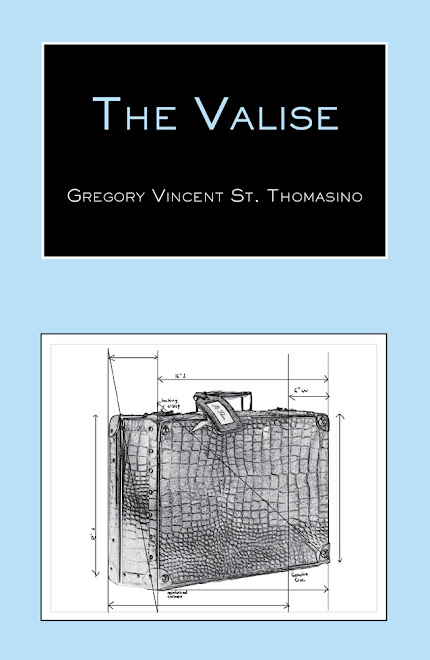
Read Me!  An interview with Carey Scott Wilkerson of Dead Academics Press, publisher of my new book of poetry, The Valise. . . .

“The discussion is wide-ranging and, in Gregory’s inimitable style, discursively reflective: a real inner-view of the artist in his philosophical universe.”  — Carey Scott Wilkerson


Spring 2012

1.  Your new book The Valise seems, in some sense, to be a series of radical containments and equally radical moments of opening.  I wonder if you develop these ideas programmatically or if they emerge as you put the collection together? 

They develop programmatically, which I do emphasize is not the same as algorithmically.  They develop as a matter of form, poetic form.  But, see, the idea is, and besides research into the poetic, the idea is to acquire for oneself a toolbox, so to speak, a technique and a style, a methodology, as these are the means by which one proceeds and as this is the stuff of one’s poetic signature.  Still, the process, and in purpose and in procedure, is one of discovery, is one of problem solving, it’s heuristic, and necessarily so. 


2.  The book’s title poem ends with absence, indeed, it ends with the provocative image: “in absence,” which is here suspended without final punctuation.  In fact, this is true of many of your poems.  And yet I feel there is here a kind of St. Thomasinian, invisible diacritical, marking a distinctly Heideggerian aufhebung, but one that struggles with the idea of ends and endings. What are the risks of leaving a poem’s final moment open to that sort of hermetic drift?  And I ask this because, as Alan Halsey observes in his description which graces the back cover of your book, you “[write] with a philosopher’s precision.” 

The subject of poetry and punctuation—and immediately I’m thinking of Dickinson and Cummings, and of Yeats and of Shakespeare’s sonnets—and of what is appropriate and of what is necessary (to convey significance in the poem) is of absolute interest to me, but first, please, let’s hold on to “a series of radical containments and equally radical moments of opening” and see these together with “absence” and “aufhebung” and what I can make of “hermetic drift.”  Containments and openings are not a matter of punctuation for me, yea punctuation is not a matter of containments and openings for me, not as such, anyway, which is to say the purpose is not to draw the reader’s attention to my punctuation, but rather and something to the contrary I intend my punctuation to be a commentary on the sentence in poetry, and which is to say I do not think the poetic can be expressed in sentence form any more (not in “traditional” sentence form, that’s for sure), it’s at once, it’s simultaneously this commentary, if you will, and is itself of the grammar of my program, which is to say of logoclasody.  I was deeply into the study of W. B. Yeats, reading all the major studies of his work and then of course A Vision, Essays and Introductions, Explorations, The Autobiography, the plays, et cetera, The Lonely Tower, The Man and the Masks, et cetera, and reading his poetry I became intrigued, obsessed, really, with his sentences, his sentence structure, and how he was writing in these long, sophisticated, sort of, and down-right, run-on sentences.  So I became very aware of his sentence structure.  And I became very aware of how poetry was written in sentences—something I, myself, was doing, but was doing unconsciously, which is to say I was writing sentences but my first intention was not to write sentences but to write poetry!  In the writing of my sentences, I was concerned with the sentence as sentence, not as a language via which my poetic is conveyed.  I discovered for myself that the grammar of the sentence is not the grammar of poetry, at any rate not of poetry as I envisioned it, not of my poetry!  This of course brought to mind the case of Dickinson, whose, quoting Linscott, “erratic punctuation and lavish use of capital letters were changed to conform to accepted usage,” and how “occasional liberties were taken with the text in order to correct grammatical vagaries or to clarify rhyme or meaning.”  And of course this brought to mind Gertrude Stein, and the punctuation of the stream of consciousness “sentence.”  The grammar of the language (of the conversation, the discourse) was as much an expression of that language (a subject matter) as was the depictions, descriptions, imagistic evocations, as was the information being conveyed.  I believe that Dickinson and Stein, and as was Yeats, and Cummings, were “programmatically” searching, exploring language in pursuit of poetry, of poetry and of its poetic elements.  This is not to say that I believe there was ever a time when poets thought of language, when they did think of language, as an innocent bystander.  I think the idea of the poem as a work of language is a given throughout history.  But the idea that language per se can be, but more than merely expressive (as we see in, say, calligraphy), the idea that language per se can be informative of its own essence, of its own eidos, and as such of a poetry that is the Poetry behind the poetry, of a poetry that is the ground of the, let us say, ostensible poetry!  This poetry that is the Poetry behind the poetry, this is the end of poetry, and by “end” think not of terminus but of “purpose,” or, more precisely, “fulfillment.”  This is what poets have always been after, and they did, and do, seek it in various and idiosyncratic ways, and whether they have realized it or not, and they have known it by the frisson that accompanies it.  It is this frisson that the poet is addicted to, this is his high and this is his reward, and with this he knows that his poetry is real.  When the poet alters his consciousness—for instance through drugs, or, even in madness, in the cultivation of madness, or in neurosis, in the cultivation of neurosis, or in the “long, intensive and reasoned (“reasoned” because with purpose!) disordering of all the senses” of Rimbaud, or in the “self-discovery” of Basho or in some or other form of self-abuse—the poet is seeking a pathway into poetry, and his frisson rewards him and guides him in his pursuit.  For myself, I don’t think this “poetry that is the Poetry behind the poetry” is to be found in “altered consciousness,” or else not exactly, rather I think it is to be found in thinking.  For myself, by way of my own explorations into language, driven by my own poetic afflatus, in pursuit of that eidos, in pursuit of this Poetry—and this includes Heidegger’s writings, and including the writings on the poet Hölderlin—I came to understand poetic language as a matter of, what did we say, “containments” and “openings,” but more as discontinuities and continuities, the word being in itself, the word as word taken in its particularity, being a discontinuity, while simultaneously being a sentence and thus being a continuity, and more in that this sentence does not become a sentence until it is perceived to be so (continuity and discontinuity are reunited in observation, or, in perception, or, in the conscious, intentional act of signification—a cardinal note of logoclasody—or, in thinking).  Consider, now, liken this to the quantum particle which is simultaneously a particle, and thus a discontinuity, and a wave, and thus a continuity, a continuum.  Discontinuity and continuity are reunited in nature.  In thinking.  So, there is the sentence as a discrete, discontinuous structure, which is to see it in its particularity, and, there is the sentence as continuous, the sentence as wave.  But the idea is not to be stuck on language, or, rather, the sentence, as a discrete, discontinuous structure, that being a word followed by a word followed by a word and so on.  The discontinuity I’m thinking about is not seen, it is not seen but it is intuited.  The discontinuity I’m thinking about is that space where in the conscious, intentional act of signification the word behind the word breaks out, and in that logical suspension thus thought is formed a continuum (to the next word).  The word behind the word—I use the Greek word for this, logos.  Logos is the word behind the word.  I think to be stuck on the idea of language as a discrete, discontinuous structure would be ignorant of the place of language, and of mind, in nature.  Language is not simply a tool for conveying information, language reveals to us the Poetry behind poetry, the word behind the word, or, if you prefer the Being behind beings, and it does this in the conscious act of signification, whereby the logos breaks out, and that’s logoclastics.  With regard to “absence,” when one packs his valise and takes leave, what he leaves behind is “his absence,” and that is what we experience about him, we know him in his absence.  He is simultaneously gone and known “in his absence.”  And to know someone “in his absence” is different, of course, than knowing him in his presence.  For one thing there’s a sentimentality involved, in the reminiscence—we know the idea in the light of that sentimentality.  Throughout most of the writing of the poems in The Valise—and one of the them, “The Crocodile,” was first published in 1998—I was writing out of a deep sense of absence, a sense of loss and, even, of grief.  The loss of my brother and then almost immediately, barely one year later, the loss of my mother, the loss of my childhood, of my “innocence.”  My deepest memories of my brother are of when we were kids living in the country in New Jersey, we were naturalists and explorers and we were quite the mythologizers, as in nothing was simply what met the eye but rather everything had a mythology and was fecund (that’s a word I associate with Yeats) with significance and with a sort of magic.  Our world was enchanted.  We used to take a broomstick and tie a white flag to the end of it and we’d go out into the dark and wave the flag high above our heads and this attracted the bats and the bats would swoop down at the flag and that was our idea of having fun.  I would say, everyone is entitled to his own mythology, and I don’t mean that of Hollywood or comic books.  One ought to, I think, make his own mythology.  A life as literature.  A grammar of one’s own.  So far as “hermetic drift,” to take it in the negative, I think no poem can be all things to everybody, no poem can be all things to poetry.  The poem has to be its own structure, and that structure, and of necessity, I think, unless your thinking haiku or an imagistic miniature, will be to a degree an instance of figure-ground.  Now this is not to draw attention away from “in absence (without period).”  The person who is “seen” in the first lines of the poem, a dancer (“an attitude”) exercising at the barre, by the end of the poem is gone, and yet something remains in her absence.  What remains?  Is it simply the mentioning in a poem?  To take it in the positive, between those first lines and that last word is depicted a hermetic drift, a stream of consciousness.  And about “marking a distinctly Heideggerian aufhebung, but one that struggles with the idea of ends and endings.”  Consider, just as the particle is still a particle even when it is a wave, the word is still a word even when it is a sentence.  There is a permanence of identity—an invariance “hidden” behind the unending mutiplicity of the senses of that identity.  Is this a trick of the mind?  Or is it in the nature of things?  (Nature, and mind, abhor a discontinuity.) 


3.  Formally, The Valise is extraordinarily disciplined, written entirely in two-lined stanzas, loosely the couplets of a venerable tradition.  I want to describe these poems as rigorously experimental, but I’m not sure that’s quite right.  Can you speak to their design? 

They are designed to make available to the reader a certain reading experience—on a poetic level, one akin to trobar clus, and on an aesthetic level one that is analogous to cubism in painting.  If you consider cubism (analytical cubism) experimental, then I suppose you can refer to a poetry, to this poetry, as experimental—experimental in the sense that, say, I’m going to write a certain way and see if I can live with the results.  And like I said above, the process is one of discovery and of problem solving, it’s heuristic, and necessarily so.  For instance, what do I mean by “cubism”?  What is a cubist poetry?  What does a cubist poetry look like?  Well, the analogy is very simple, it’s based on faceted form.  It’s the analogy between the geometric structure of the painting and the grammar of the poetry (of the sentence).  To facet grammar is to break it up, but not to break it up gratuitously or “by chance,” you have to understand the parts of grammar and know how they function.  It’s not just a matter of breaking up syntax—you’re not just putting syntax into disarray.  If something is “rigorously experimental,” then it is both theoretically and experimentally rigorous.  Writing in couplets (and in sonnets) seems intuitively and organically very comfortable for me.  I have no problem using the term “couplets,” and I do intend mine to be more than just units of a couple of lines each.  Here’s an example, from The Valise. 


The Crocodile

in stress and carriage
in darning pleats and salts

and bearing certain ordinary likenesses
or to pass, unrecognized

in tide.
in shallows and remove

in summer lists and anthem
is making face of boot and purse


4.  “The Archaeology of Palestine,” a Pushcart-Nominated poem, encodes the intimacy of things lost to time but holds history up to the tests and texts of its “didaskalos” and inscribes “the names” and “the letters” in the proving grounds of imaginative experience.  How, as an artist, do you reconcile the power of art with the twin forces of the “wand and schedule of tides”? 

“Wand and schedule of tides,” that’s Moses.  This is his science and his magic.  His gramarye. Moses was in conversation with God.  Jesus, the didaskalos, gave his disciples a language, a prayer, with which to have a conversation with God, it’s called, Oratio Dominica, or, “The Lord’s Prayer.”  I think by “power of art” we mean the power art has to evoke a time and a place and an experience and to make available to the reader an insight.  If there is no insight, the work runs the risk of being gratuitous, and exploitative (—art can disseminate propaganda, and art can degenerate into “agitprop”).  The power of art is its power to bear witness.  (And that is through depiction.  The language of art is not the “message” one writes in however “artistic” a fashion on a placard to be carried during a demonstration, it’s a language of symbols and of depiction.  Otherwise there’s a risk the “art,” with its power to enchant, can lead to deception.) 


5.  Will language survive its own competing narratives? 

Well, by “language,” let’s say we mean “poetic language.”  The language of poetry.  Let’s say we just mean poetry.  Now there’s a lot of poetry that we can call, and that I do call, “ordinary language poetry,” that is exactly the sort of poetry I am not talking about.  And by “narratives,” let us say the narratives of technology, and I’ll define “technology.”  By “technology” I mean “ordinary language.”  And, certainly, “ordinary language” can include symbols and depictions, “ordinary language” is also computer code.  So I make a distinction between “poetic language” and “ordinary language.”  “Ordinary language” gives us information.  “Poetic language” does more than give us information, it, as I said above, reveals the Poetry behind the poetry, the word (or, logos) behind the word.  (Doesn’t all language do this?  Yes, but in poetry we celebrate it, we practice it for the sake of it, in poetry we write in the consciousness of it, we sing of it.)  Here’s an idea: The poet as generator of language.  In what sense is the poet a “generator of language”?  The poet is a generator of language in that he produces metaphors and metaphors produce semantic changes and semantic changes increase language.  In this, poets are in competition with “technology” which also generates language, language in the form of, for instance, neologisms, catch-phrases, slogans, for example “the one-percent,” “the ninety-nine percent,” these slogans compete with “the road not taken.”  Will language survive?  Yes: Language has had the first laugh and language will have the last laugh.